
Nationalisation and Privatisation
What might Andy Burnham's remarks imply for the energy sector?

There is now something of a ritual amongst prospective Labour leaders, whereby they must speak the words that their electorate wish to hear if they are to withstand the ballot. “The words,” are commitments to nationalisation of key industries. Under Starmer this commitment became noncommital as the electorate he faced changed from Labour members to the broader British public. There is a sense in which this is all kayfabe for the purposes of winning power; a successful Labour politician must be seen to wear the clothes of a socialist without ever becoming one.
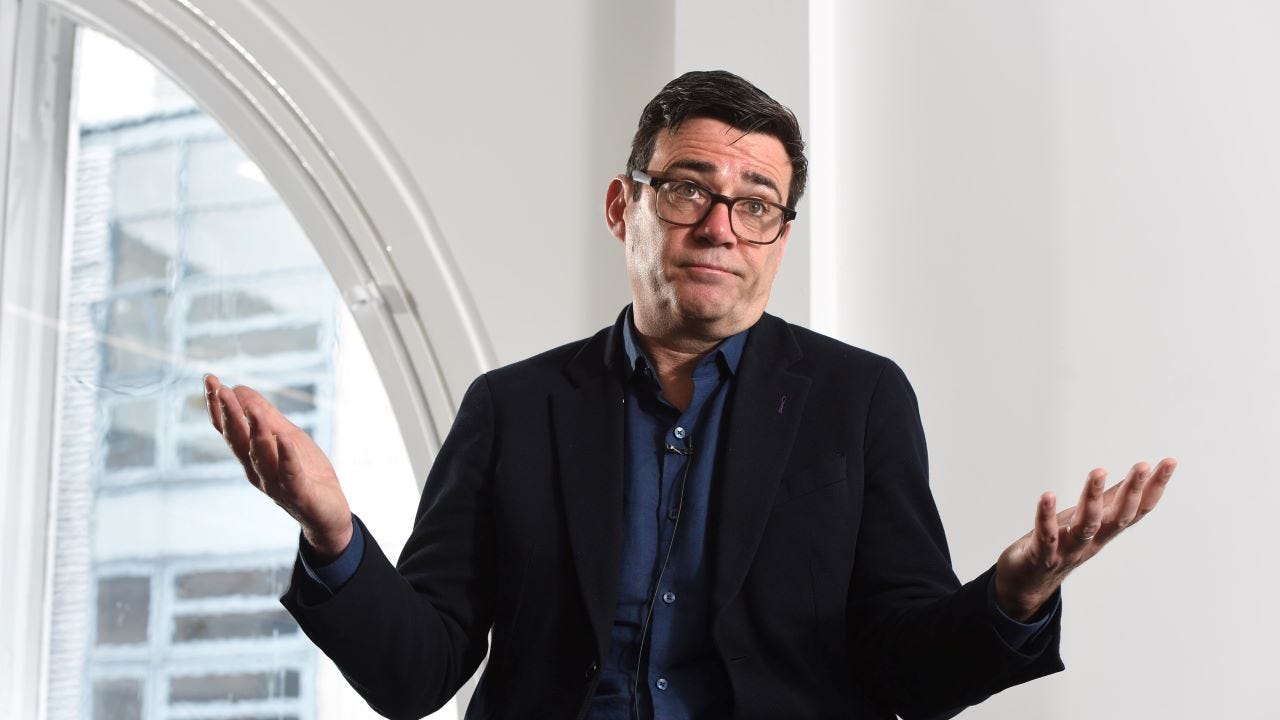
Whether the newest entrant in Labour’s internal Royal Rumble, Andy Burnham, is Sartre’s waiter is a question we will not resolve today. What we will consider today is what his recent intervention on public control of key industries (especially energy) (a) could mean and (b) how we can properly describe the problem it is intended to solve.
Firstly, ‘public control’, Burnham’s careful phrase, is not the same as ownership. The Bees transport network in Greater Manchester is publicly controlled through a franchise initiated by Burnham. Fares and timetables are determined by the local government. However, the actual assets are owned and operated by the private sector.
For the energy sector, this is seemingly not that dissimilar to the current regime. Retail business models are almost wholly determined by licence arrangements established by the regulator Ofgem, the projects undertaken by network companies are determined by the publicly owner National Energy System Operator (NESO) and the generation that enters the market is largely determined by central government contracting. A Burnham-style move towards greater public control would therefore, on the face of it, represent an evolution rather than a revolution.
The problem that we have is that it is unclear that evolving the current regime would meaningfully tackle Britain’s persistently high electricity prices. Public control is currently at its zenith, following the reforms introduced by the Conservatives such as the price control and continued by Labour in its centralisation of network planning. Thus far Burnham has laid out no theory of change that would explain how Ofgem adding a couple of hundred pages more to the supplier licence would cut bills. We will explore here what this could look like.
United Tribes
We should assume that any future Labour leadership contest will cover the future of the utilities sector in some detail. We can see the parameters of this debate in the contributions made variously by the Tribune group of MPs, especially Yuan Yang, and the Labour Growth Group under Chris Curtis. If I can characterise this very roughly, the Tribune group are calling for much more direct state intervention in the sector up to and including nationalisation, while the Labour Growth Group are calling for more market rigour to be applied to existing private actors. Both are calling for Thames Water, the most benighted utility, to be placed into the Special Administration Regime that is the utility equivalent of bankruptcy.
This latter is important, because it points to the sense that the status quo is not working. If there is to be a debate, it is helpful to set out the parameters of it. Burnham’s language on public control above points to a complexity: this is not purely a question of public ownership.
On the Public Welfare
But we get ahead of ourselves. The first question one should answer when thinking about utilities policy is what one is seeking to achieve. This is important because whether you think utilities exist to provide a service or whether you think they are also vehicles for social policy1 will determine how you will approach the problem. You may prioritise low cost services or you may prioritise services that include public protections of some kind; public protections cost money and if that money is raised from all customers of that utility you are implicitly not opting for low cost services.
The second question is how best to manage utilities to provide the objective you have specified. Here is where questions of nationalisation versus privatisation come into play, but also questions of public control versus private control as well as the role of competition. We will discuss these below.
Publicly Owned
After World War 2 the many independent electrical undertakings across the country were integrated into a new centralised national industry. This followed on from a first round of integration in the 1920s under the Central Electricity Board that constructed the first national grid. The first round of integration had seen considerable benefits flow to consumers: a broader customer base for generators meant they could run more efficiently and defray their fixed costs over a wider pool. This meant the cost of electricity declined and its use expanded. The post-war round saw the new Central Electricity Generation Board (CEGB), established as a body with limited Government oversight and considerable abilities to act as it saw fit, achieve a similar success. Power prices fell again and demand increased.
But this initial flourish of state-backed entrepreneurship was not to last. As the state started to expand its influence over the CEGB the pressure to misallocate capital in line with political preferences increased. In 1983 the Monopolies & Mergers Commission found that the CEGB had over-built generation as a function of over-optimistic demand projections. These projections were driven in part by the Government’s own optimism at its ability to deliver economic growth. The billpayer would still need to pay for these excess power stations, however, and Treasury guarantees for finance meant the taxpayer would need to pick up the bill if they did not. Regardless, the price of power in 1989, on the eve of privatisation, was the lowest in real terms it has ever been.
This latter point may rather seem like a slam dunk for public ownership, and there is indeed evidence that the CEGB was rather better at building electrical infrastructure than private operators. In part, this was a function of low friction between the publicly owned body and the rest of the State. It is much easier to get permission to build a new cable or power station if you can call up the Secretary of State and prompt them to make a decision. But before we hoist the red flag and set sail for Full Communism Now, it is worth noting that although the CEGB was publicly owned its distance from Government meant that it was de facto privately controlled. Inasmuch as the Government is the vehicle for organising the common affairs of the public, the public had remarkably little input into its workings. Arguably our current structures of governance represent considerably greater public control over the the energy system than the CEGB was ever subject to.
We could therefore reasonably argue that it was creeping public control that drove the capital misallocation for which the CEGB was held to account by the Monopolies and Mergers Commission. We will return to this point.
The rigours of the market
Demand projections for energy are important, because electricity generators are large infrastructure projects that take many years to deliver. A key question is therefore who bears the costs of getting such projections wrong. Part of the case for privatisation of the electricity industry was that billpayers - and taxpayers - should not be on the hook for failures to predict the future. Rather it should be investors, who would stand to lose their shirt if they built a spanking new power station and demand failed to turn up. This would create an incredibly acute focus on getting those projections right, and thus minimise misallocation of capital at the level of society.
A second part of the case was that the profit motive would drive efficiencies in management and operation that the public sector could not hope to match. In the outturn this appears to have been true. However, consumers failed to actually benefit from these efficiencies, with most of the upside flowing to plant owners rather than the public. This appears to have been a function of a market design that enabled the new incumbent generators to game price formation in an algorithmically determined market.
The third part of the case was about that point in particular: the assumption that markets would drive consumer value through enabling prices to better internalise distributed information more efficiently than the centralised CEGB ever could. But that relies on price formation being efficient - i.e. actually reflecting the material reality of how much it cost to run a given generator as opposed to another one. The first stab at a market having failed, it was replaced with the New Electricity Trading Arrangements in the early 2000s. Rather than a central algorithm electricity is now traded bilaterally between generators and suppliers, paying networks regulated charges to carry the traded power. Everyone definitely agrees that NETA is absolutely fine in the current age.
In the outturn, it is remarkably hard to define market arrangements that deliver efficient pricing. It is arguable that our current market arrangements worked well over the 2000s, creating space in prices to let Government pursue further goals such as decarbonisation via an emissions trading scheme plus deployment incentives. It is much less clear that they have responded to a changing generation mix in an efficient fashion. But this is a topic for another day.
The axes of choice
We can now define three independent variables that apply to utilities policy:
Public ownership versus private ownership;
Public control versus private control, and;
Markets versus command and control.
This helps us to analyse Burnham’s reference to public control above. The Bees network is governed by a joint transport committee that includes the Greater Manchester Combined Authority, the ten councils of Greater Manchester, and the Mayor’s office. This committee makes strategic decisions, such as investment. However, actual day-to-day operations are undertaken by Transport for Greater Manchester, while as said the buses involved are owned and operated by private contractors. There is therefore a degree of private control - that is, control specific to the organisation rather than overlapping State authority - implicit in its structure. This specialisation is important for anticipating what a Burnham-esque framework for utilities might be: a trade off between public control for relevant public goods versus more specialist private control for actual operation, with private companies focusing on specified delivery tasks.
For electricity, this implies a significant degree of change in governance. Currently both strategic and operational decisions are split across DESNZ, Ofgem and NESO. Recreating a Bees-style structure would imply a Cabinet Committee overseeing the system and a single delivery body that merges NESO, Ofgem and relevant parts of DESNZ. The role of private companies in the system would be reduced to providing specific services as contracted by the delivery body, and competition would be focused on the issuing of contracts rather than consumer choice.
This is rather revolutionary compared to our current system and the transition to such an arrangement would be no easy task. The specialisation of delivery it engenders has much to recommend it - this, essentially, was the CEGB’s secret sauce - but whether the Government can limit public control in the name of efficiency is unclear. Public control appears to impede efficiency through centralisation of standards for e.g. hiring and contracting that may not be relevant to bodies with specific roles in the market or may be over-prescribed compared to the level of risk involved. We know from the application of Civil Service standards to Great British Energy that Whitehall is remarkably reluctant to accept that its standards might not be applicable to every public body, implying that a Bees framework would be rendered impotent from inception.
Fundamentally, however, such an overhaul would likely make it nearly impossible for Government to achieve its 2030 power decarbonisation targets. The level of uncertainty for investors would simply be too great. A future Prime Minister Burnham may need to choose between his Chancellor and Ed Miliband. Who may end up being the same person.
It is a matter of some regret that UK governments of every stripe have opted down this latter route by using utility policy to determine what the least well off should be spending money on (see the Warm Homes Discount, for example) rather than assuming they are adults with agency and simply solving their poverty by giving them money.
A good article that seems to omit that the real reason for privatisation was to limit the ability of Trade Unions to challenge the will of government